PEMODELAN PEMBELAJARAN PROBLEM BASED LEARNING BERBASIS ISU BENCANA UNTUK GURU IPA DI SMP MUHAMMADIYAH MERAUKE
DOI:
https://doi.org/10.37478/mahajana.v6i3.6816Abstract
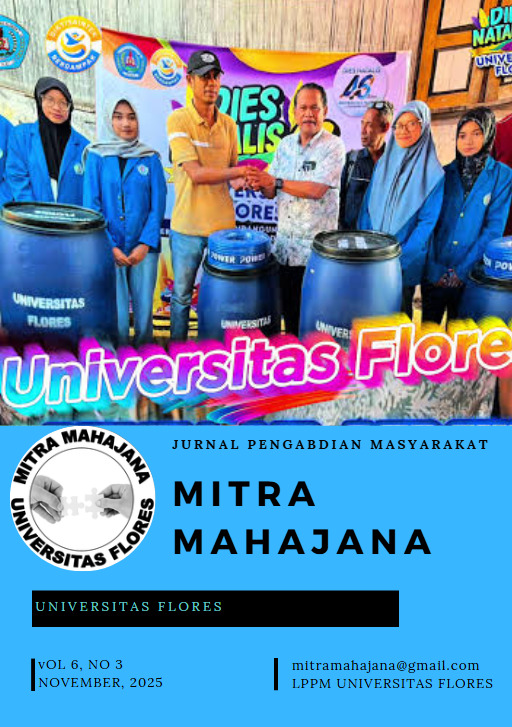
Merauke, as a region with a very large potential for flooding, requires early preparedness, one of which is through the integration of disaster mitigation education into school learning. This community service program aims to improve the capacity of science teachers at Muhammadiyah Merauke Middle School in modelling and implementing Problem-Based Learning (PBL) that utilises Artificial Intelligence (AI) technology, Educafe, and Curipod in the context of disaster issues. The implementation method includes a pretest, intensive training (workshop), independent practice mentoring, and a posttest. The training was attended by 10 teachers (3 science teachers and 7 non-science teachers) and 9 Physics education students from Musamus University as co-facilitators. The pretest results showed that teachers' understanding of disaster-based PBL and the use of AI in learning is still relatively low. The training focused on strengthening the concept of PBL, analysing the disaster context in Merauke, and practising using AI Education platforms such as AI Educafe and Curipod to design LKPD and interactive learning media provided by the AI ??education platform. Post-test results showed significant improvements in teachers' conceptual understanding and technical skills in designing learning. This activity concludes that the hybrid training model (theory, practice, and mentoring) is effective in improving teacher competency. Collaboration with students also creates a mutually beneficial learning ecosystem. Continued mentoring and the development of more contextual digital modules are recommended.
Downloads
Keywords:
artificial intelligence, disaster mitigation, problem based learningReferences
Al Abri, M., Al Mamari, A., & Al Marzouqi, Z. (2025). Exploring the implications of generative-AI tools in teaching and learning practices. Journal of Education and E-Learning Research, 12(1), 31–41. https://doi.org/10.20448/jeelr.v12i1.6355
Auliah, F. N., Febriyanti, N., & Rustini, T. (2023). Analisis Hambatan Guru dalam Penerapan Model Problem Based Learning. Journal on Education, 5(2), 2025–2033. DOI: https://doi.org/10.31004/joe.v5i2.846
Ekasari, A., & Putra, D. J. (2024). Error Analysis of Learners’ Problem-Solving Abilities in Mathematics Courses: A Newman Error Analysis (NEA) Approach. Jurnal Pendidikan Sains, 12(1), 44–49. https://doi.org/10.17977/jps.v12i12024p044
Hidayat, Z., & Yatminiwati, M. (2023). The Role of Local Wisdom-Based Disaster Education and Training Through Education Levels in Disaster-Prone Areas. International Journal of Accounting and Management Research, 4(1), 1–8. https://doi.org/10.30741/ijamr.v4i1.991
Holmes, W., & Porayska-Pomsta, K. (2022). Artificial intelligence in education: Contexts, methods and implications for teaching and learning. Journal of Learning Analytics, 9(1), 1–20.
Jaya Putra, D., Algiranto, A., Ekasari, A., & Inyang, F. (2024). Analysis of the Quality of Physics Textbooks in the 2013 Curriculum and the Independent Curriculum. EduFisika: Jurnal Pendidikan Fisika, 9(2), 226–238. https://doi.org/10.59052/edufisika.v9i2.36876
KemenPUPR. (2021). Modul 07 Penanggulangan Bencana Banjir Tahun 2021. Pusat Pengembangan Kompetensi Sumber Daya Air Dan Pemukiman, 6. Jakarta: Kementrian PUPR
Lestari, W., Dwiningrum, S. I. A., Sujarwo, Azhari, I., & Damanik, I. H. (2025). Evaluating the effectiveness of local wisdom-based disaster mitigation education in primary schools. Edelweiss Applied Science and Technology, 9(5), 2074–2091. https://doi.org/10.55214/25768484.v9i5.7380
Masocha, W., Takaidza, N., Manyani, A., & Mutseekwa, C. (2025). Disaster risk reduction integration into school curriculum: A global analysis. European Journal of Sustainable Development Research, 9(1). https://doi.org/10.29333/ejosdr/15820
Nurcholis, D., & Putra, D. J. (2025). Pelatihan Kepemimpinan Dasar bagi Ikatan Pelajar Muhammadiyah SMA Plus Muhammadiyah Merauke sebagai Upaya Meningkatkan Kapasitas Organisasi Siswa. 1(5), 1124–1131.
Partini, D., & Hidayaht, A. N. (2024). Disaster risk reduction efforts through education in Indonesia: A literature review. IOP Conference Series: Earth and Environmental Science, 1314(1), 0–10. https://doi.org/10.1088/1755-1315/1314/1/012049
Putra, D. J., & Rahman, Z. (2019). The role of guidance and counseling teacher in solving students’learning difficulties in physics. Journal of Physics: Conference Series, 1321(3). https://doi.org/10.1088/1742-6596/1321/3/032056
Putra, D. J., Simbolon, M., & Ekasari, M. (2023). Analysis of Scientific Literacy Ability of Students of The Physics Education Study Program at Musamus University. Technium Social Sciences Journal, 49(1), 417–422. https://doi.org/10.47577/tssj.v49i1.9835
Tan, X., Cheng, G., & Ling, M. H. (2025). Artificial intelligence in teaching and teacher professional development: A systematic review. Computers and Education: Artificial Intelligence, 100355. https://doi.org/10.1016/j.caeai.2024.100355
Downloads
Published
How to Cite
Issue
Section
License
Copyright (c) 2025 Don Jaya Putra, Aprilita Ekasari

This work is licensed under a Creative Commons Attribution-ShareAlike 4.0 International License.
The authors and other parties are bound to the Attribution-ShareAlike 4.0 International license (CC BY-SA 4.0 DEED) for the published articles. This permits users to:
Share — copy and redistribute the material in any medium or format for any purpose, even commercially.
Adapt — remix, transform, and build upon the material for any purpose, even commercially.
The licensor cannot revoke these freedoms as long as you follow the license terms.
Under the following terms:
Attribution — You must give appropriate credit , provide a link to the license, and indicate if changes were made . You may do so in any reasonable manner, but not in any way that suggests the licensor endorses you or your use.
ShareAlike — If you remix, transform, or build upon the material, you must distribute your contributions under the same license as the original.
No additional restrictions — You may not apply legal terms or technological measures that legally restrict others from doing anything the license permits.